
Senator Whitehouse, Please Correct The Congressional Record
Senator Wildthing’s Climate Math: Juuust a Bit Outside

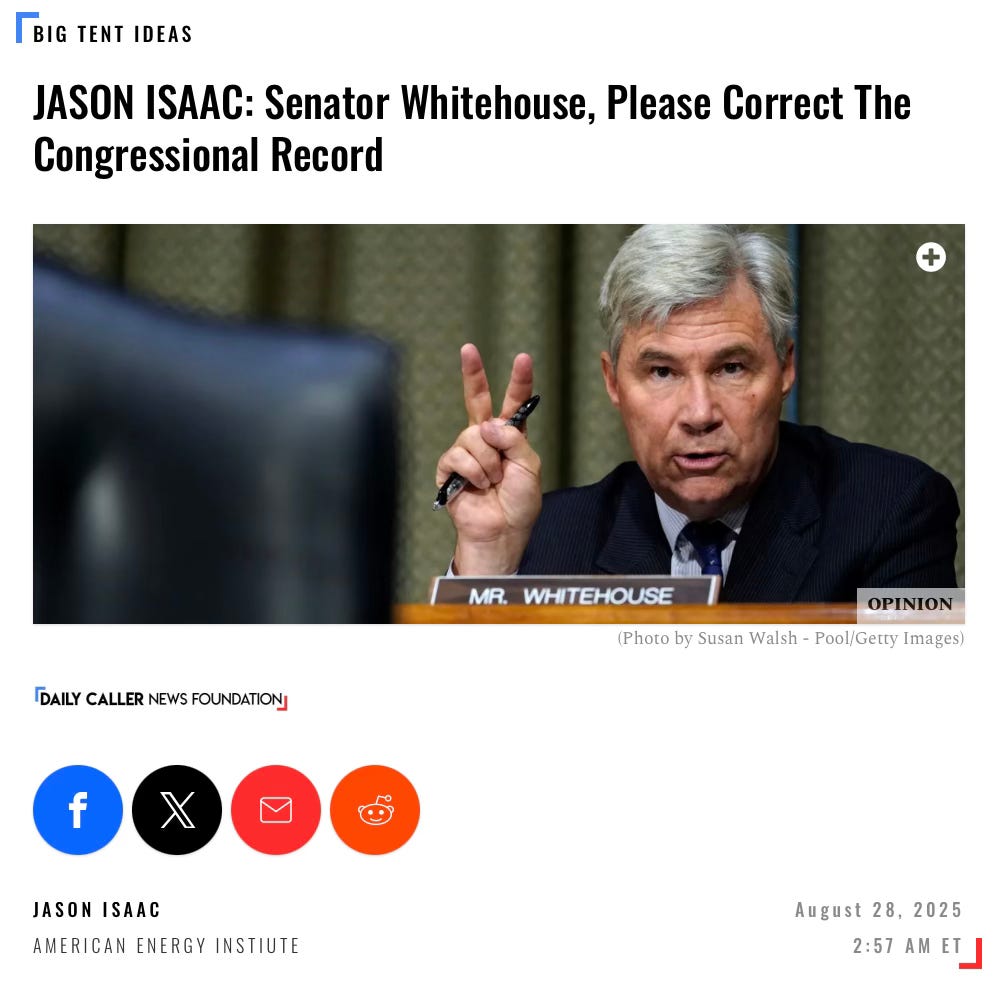
Every so often, a story perfectly captures the problem with the way climate “science” is sold to the public and policymakers. The recent Washington Post report on a deeply flawed, headline-grabbing climate economics study is one of those stories, with a twist. This study didn’t just make waves in the media; it made its way into the United States Congressional Record, courtesy of Senator Sheldon Whitehouse.
In 2024, Whitehouse took to the Senate floor with his “trusty battered ‘Time to Wake Up’ chart” to warn of trillions in climate damages. As one of his key pieces of evidence, he cited a study from the Potsdam Institute for Climate Impact Research, published in Nature, which claimed the world was on track to lose 19 percent of global GDP by 2050, and a staggering 62 percent by 2100.
There was just one problem: the science wasn’t just bad; it was absurd.
According to the Washington Post, a fresh analysis found the study’s projections rested almost entirely on faulty economic data from one country: Uzbekistan. In the dataset, Uzbekistan’s GDP supposedly plunged 90 percent in 2000 and then jumped 90 percent in 2010, with other wild swings in between, numbers the World Bank says bear little resemblance to reality.
Those errors drove the model’s catastrophic projections. Remove Uzbekistan, and the projected GDP loss in 2100 drops from 62 percent to 23 percent. For 2050, the damage falls from 19 percent to 6 percent, less than one-third of what Whitehouse read into the Congressional Record.
In other words, a country representing just 0.2 percent of global GDP, with wildly erroneous data, dictated the economic future of the planet, at least according to Nature and the Senator from Rhode Island.
Rather than retract the paper, the authors “reworked” their methodology to produce numbers still roughly in line with their original conclusions. As Stanford’s Solomon Hsiang, who uncovered the error, put it: “Science doesn’t work by changing the setup of an experiment to get the answer you want.” Too much of climate economics works exactly that way — start with the conclusion, then adjust the methods until the numbers fit.
Studies like this aren’t just academic exercises; they’re political weapons. Whitehouse used the Potsdam numbers to push sweeping climate policies, warning of “massive economic damages” and tens of trillions in losses. These figures influenced the U.S. government and the World Bank. Now we know they were inflated beyond recognition by a single bad datapoint.
The irony writes itself. Whitehouse has built his career warning about “misinformation” and demanding accountability for those who spread false or misleading climate claims. Yet here he is, having put error-driven projections into the Congressional Record.
If he believes in holding others to account, he should start with himself. Whitehouse should file the paperwork and strike the flawed claim from the record.
Just months ago, the president signed the Executive Order on Restoring Gold Standard Science. It defines trustworthy science as reproducible, transparent, communicative of error and uncertainty, collaborative, skeptical of its own assumptions, structured for falsifiability of hypotheses, subject to unbiased peer review, open to negative results, and free from conflicts of interest.
It was a welcome move, and, as events quickly proved, a prescient one as the Nature study fails nearly every one of those tests. Its results couldn’t be replicated. It wasn’t transparent about a glaring data flaw. Peer review missed the problem entirely. And when challenged, its authors altered their methods to preserve their conclusions. Perhaps it’s time for NASA, NIH, DOE, and other agencies to cancel their taxpayer-funded subscriptions to Nature.
For decades, the climate policy debate has been dominated by apocalyptic scenarios built on speculative models and selective data. When those models collapse, the political machine rarely pauses; it simply finds another “landmark study” until that one, too, falls apart under scrutiny.
Whitehouse’s Uzbekistan problem is more than a punchline; it’s a case study in why the public is right to be skeptical, and why the “Gold Standard Science” EO matters.
So, Senator, here’s my modest proposal: correct the record. Lead by example. Show that in the climate debate, accuracy matters more than alarmism. And next time a study predicts tens of trillions in losses, ask whether it meets the Gold Standard Science test before turning it into another “Time to Wake Up” speech. You might just find Uzbekistan hiding in the footnotes.
Originally published in the Daily Caller at 11:57 AM (Uzbekistan Time) on August 28, 2025
Shades of Michael Mann's single tree and the hockey stick that is now rendered as kindling on a fire of fatuity
My Story,
BY Steve Heins
1. Life
I am Steve Heins, eighty-one years, a spark in the vast fire of being,
No college degrees to hang on my wall, no parchment to claim my worth,
Yet Columbia whispered, two French courses shy, and I learned from the world’s own book.
I have been a small-town boy, dirt under my nails from golf,
chasing greased pigs through county fairs,
Six times I won, the crowd roaring, the mud my crown, my youth a wild, unbridled song.
I have swung clubs as a scratch golfer, danced on basketball courts, my body a rhythm of motion,
I have drifted, interstate highways my veins, truck stop restaurants my temples, high plains and low my congregation.
Big-city student man, I claimed the neon pulse, skyscrapers my stars,
Yet I wandered, self-indulgent, a distant father, my heart sometimes lost in the haze.
Auto-didact, I stormed Ivy halls, no gatekeeper to bar my way,
Scholar, student, historian, I devoured books, art, music—pages my kin, symphonies my breath.
I have been a poet, words my chisel, carving truth from the stone of days,
A poetry aficionado, lover of verses that sing the soul’s quiet and its storms.
Lost soul, I’ve roamed, yet found my place in the vastness,
Eighty-one years, I stand, a blizzard of one, my life a canvas of collisions, still painting.
2. Career
I am a business writer, economist, my pen a torch in the dark of markets,
Researcher, communicator, I weave stories for the weary, the hopeful, the seeking.
Wall Street knew me, mutual fund director, shaping wealth’s pulse,
I spoke to traders, to dreamers, my words a bridge between chaos and clarity.
I am the Blizzard of One, storming broadband’s gates, defying Goliath’s shadow,
Internet Open Access my banner, freedom my cry, a digital dawn for every voice.
Practical environmentalist, I named myself, no dogma to chain my sight,
Energy efficiency my craft, lighting the world with a realist’s spark.
Chicago Climate Exchange, I was there, building markets for carbon’s weight,
Paris, I stood in its ancient halls, speaking to the EU’s schemers, my vision for emissions a map.
Lobbyist, I walked fifty states, D.C.’s marble my battleground,
For energy efficiency, for natural gas, for nuclear’s hum,
I fought, my voice a gadfly’s sting.
Technology theorist, I dreamed in clouds, saw the future in circuits and code,
Bakken Basin, I spoke, The Weekly Word my stage, Professor Heins my name.
With experts—geologists, physicists, skeptics—they joined me, their truths a chorus,
We broke the noise, our podcast a fire, burning for sane energy, for human thriving.
ESG I weigh, fair and balanced, my skeptic’s eye unfooled by greenwashed hymns,
Political organizer, pain in the ass, I stir the pot, I wake the sleeping.
Tens of thousand articles, my ink and my friends a river, The Word Merchant’s flood across nations,
Curator, I gather truths, feeding allies—scientists, journalists—with light against the dark.
Self-financed, unbowed, at eighty-one, I am the storm that never quiets,
Sane energy my job, my cause, my heart’s unyielding vow.
This is my confession, my map, my open book,
Steve Heins, poet, fighter, a life of words and wars, still singing.