
🚨 BREAKING: Vanguard Settles Antitrust Lawsuit ⚖️
First to Fold: Vanguard’s $29.5 Million Exit From the Climate Cartel Case

Today marks a major turning point in the legal battle against Wall Street’s climate cartel.
Vanguard, one of the three asset management giants accused of colluding to suppress coal production, has agreed to settle the multistate antitrust lawsuit led by Texas Attorney General Ken Paxton and a coalition of Republican attorneys general. Rather than proceed through discovery and trial, Vanguard will pay $29.5 million and accept significant structural restrictions on its conduct.
This is not a symbolic outcome. It is the first major fracture in the coordinated ESG regime that has attempted to steer U.S. energy and agriculture markets from the boardroom.
What Vanguard Agreed To
According to the Texas Attorney General, “Vanguard has chosen to protect investors and become the industry leader when it comes to empowering investors with proxy voting choice. This sets a new standard for institutional investors that every company should follow,”
Among the key terms:
Vanguard will pay a $29.5 million fine.
Vanguard will no longer use its shareholdings to dictate corporate business strategies.
Vanguard will not threaten to withdraw investments to pressure companies into ideological commitments.
Vanguard will not nominate directors or shareholder proposals designed to distort market output.
Vanguard agreed to expand proxy voting choice and allow investors to vote their own shares.
That last point is transformative.
For years, Vanguard and its peers voted trillions of dollars in shares on behalf of investors without meaningful client control. The same month as the federal judge’s ruling, Consumers’ Research and the American Energy Institute published research showing that those votes were often aligned with coordinated climate initiatives that targeted coal, oil, gas, and even agriculture. Now, investors themselves will have the ability to determine how their shares are voted.
That shifts power away from centralized ESG committees and back to actual shareholders.
Why This Happened Now
This settlement did not occur in a vacuum.
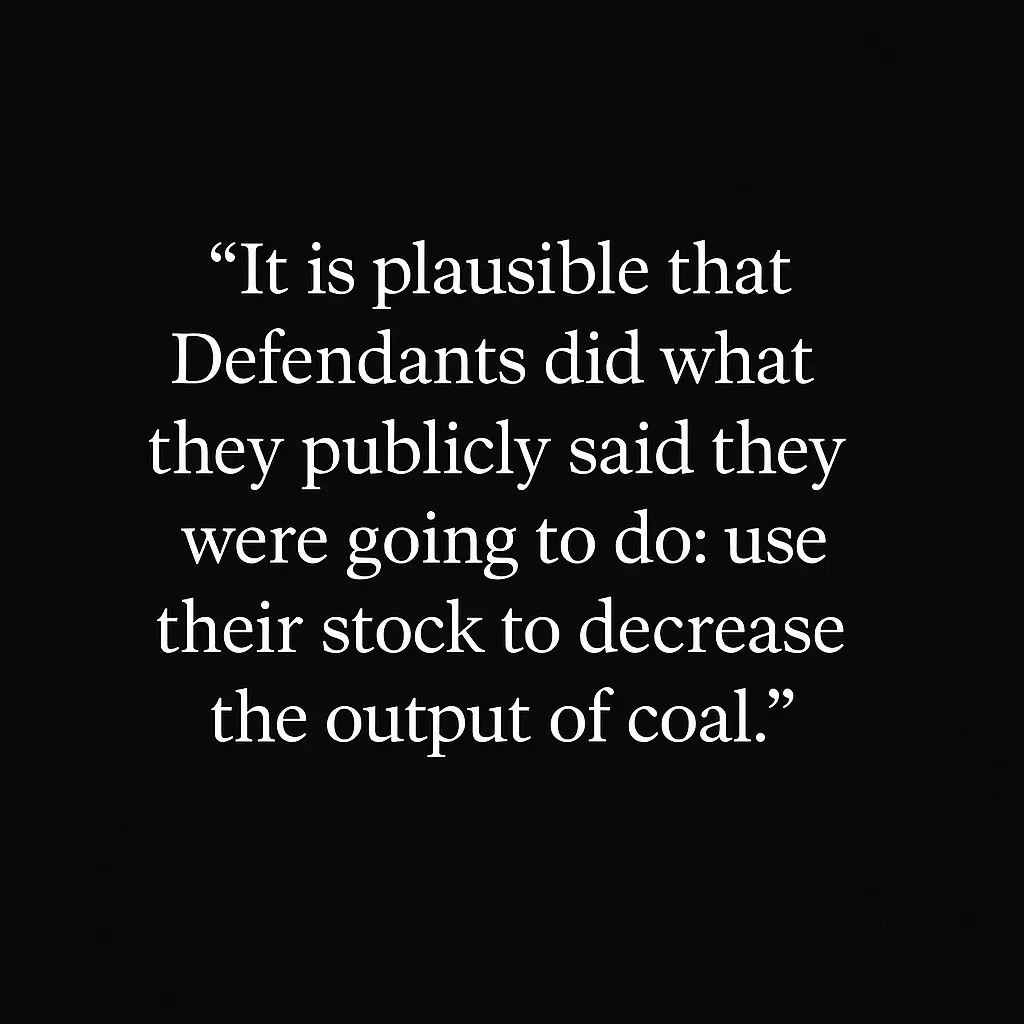
Last year, a federal judge refused to dismiss the antitrust lawsuit against Vanguard, BlackRock, and State Street. The court made clear the plaintiffs had alleged detailed and plausible claims that the firms used their substantial stock ownership to pressure coal companies to reduce production.
The judge went further, stating it was plausible the defendants did what they publicly committed to do, use their stock to decrease coal output.
That ruling changed the risk calculus.
Once the case survived dismissal, discovery became real. Internal communications. Proxy coordination. Climate initiative strategy discussions. All of it potentially subject to court scrutiny.
One of the Big Three chose not to take that path.
The Passive Investor Defense Is Cracking
For years, the asset management industry has shielded itself behind the claim of passivity. They are merely indexing. Merely tracking markets. Merely stewards.
The court rejected the notion that the antitrust safe harbor protects investors who use proxy voting or coordinated engagement to substantially lessen competition.
Now Vanguard has agreed to binding passivity commitments as part of its exit.
If this were nothing more than routine index management, there would be nothing to fix.
Instead, Vanguard has agreed to structural limits on how it uses shareholder power.
That speaks volumes.
The Fight Is Not Over
BlackRock and State Street remain defendants.
The core legal theory remains intact.
The antitrust challenge to coordinated ESG pressure campaigns is still moving forward. If anything, Vanguard’s departure increases pressure on the remaining firms.
Attorney General Paxton called this an industry-changing agreement. He is correct. It establishes that coordinated climate activism through asset management is not beyond the reach of state antitrust law.
For years, Wall Street attempted to rewrite energy policy without legislation, without voters, and without accountability. They leveraged concentrated ownership stakes to push production declines and advance net-zero commitments that directly impact reliability, affordability, and economic growth.
Today, that strategy took a hit.
The climate cartel is no longer operating in the shadows without consequence. One of its largest members has paid to exit the battlefield and agreed to change its behavior.
This is not the end of the fight.
It is the beginning of accountability.
That is the best news I’ve heard all day!
Bravo!!